If you’re weighing up heat pump vs solar hot water, you’re in good company. Hot water is one of the bigger energy users in many Australian homes, and choosing the right system can make a real difference to your power bills and emissions. In fact, the Australian Government’s YourHome guide notes that around 23% of energy used in an average Australian home can go to heating water.
The tricky part is that there’s no single “best” system for everyone. Roof space, shading, climate, household size, business usage, existing solar PV, and even where you can physically place equipment all matter. This guide breaks down solar hot water vs heat pump in Australia
Heat pump vs solar hot water: what’s the main difference?
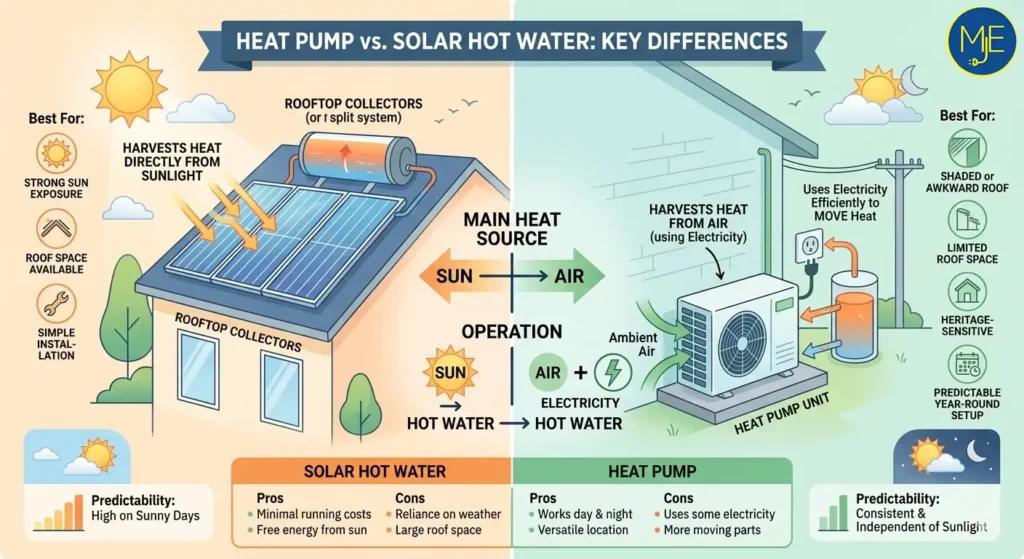
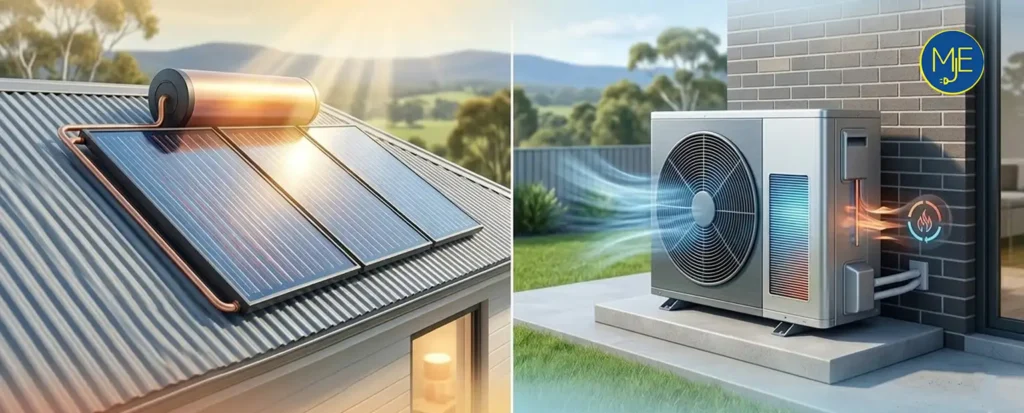
A solar hot water system uses rooftop collectors, either flat panels or evacuated tubes, to capture the sun’s heat and warm water in a storage tank. A heat pump uses a refrigeration cycle to pull heat out of the outside air and transfer it into water stored in a tank, a bit like an air conditioner working in reverse.
In practical terms, solar hot water is most “at home” where the roof has strong sun exposure and the installation is straightforward. Heat pumps tend to shine where roof space is limited, shaded, awkward, heritage sensitive, or you simply want a more predictable year-round setup without relying on sunshine.
A good way to think about it is this: solar hot water harvests heat directly from the sun, while heat pumps harvest heat from the air using electricity to move that heat efficiently.
Which is cheaper to run in Australia?
For many households, a modern heat pump can be very cheap to run because it uses much less electricity than a standard electric storage hot water system. Heat pump water heaters are highly efficient and can use around 30% of the energy of a conventional electric hot water system.
Solar hot water can also be cheap to run because sunlight is free, but running costs depend heavily on how often the system needs boosting. In areas with less mid-year sun and long cold nights, solar hot water may need an electric or gas booster more often, which can push costs up.
What usually makes the biggest difference is how you use hot water. If most of your hot water demand is in the morning and evening, a heat pump that reheats efficiently overnight can be a strong match. If you have consistent daytime use, solar hot water can perform well when the sun is doing the heavy lifting.
Which performs better in winter and cold climates?
Winter is where the comparison gets real. Solar hot water output drops when days are shorter and cloudier, and when nights are long and cold. That’s why boosters are common, especially in cooler regions.
Heat pumps keep working in winter, but performance depends on the model and the local climate. Not all heat pump models are designed for cold locations where temperatures regularly drop below about 5°C in winter.
So which is “better” in winter? If you’re in a cold area, both can work, but the safest approach is choosing a heat pump designed for cold conditions, or ensuring a solar hot water system has an appropriate boosting strategy. For many Australian climates, a well-specified heat pump gives more predictable winter performance because it doesn’t rely on direct sunshine.
What if my roof is shaded, small, or just not suitable?
This is one of the biggest reasons Australians choose heat pumps. Heat pumps do not require rooftop collectors, making them ideal where solar access is poor.
Solar hot water needs roof real estate with good sun exposure and room for collectors, plus the right orientation and tilt. If your roof is shaded by trees, neighbouring buildings, or you’re dealing with a complex roofline, solar hot water can become more expensive and less effective.
Heat pumps are usually installed at ground level as an integrated unit or as a split system with a separate tank and outdoor compressor. The main “roof requirement” becomes none at all, which is a relief for many homes and plenty of commercial sites too.
Which is easier and faster to install?
Solar hot water installation typically involves roof work to mount collectors or tubes, plus plumbing lines between the roof and the tank, and then a booster connection. The Australian Government describes solar hot water systems as consisting of collectors and a storage tank unit, which can be installed on the roof or at ground level.
Heat pump installations are often more straightforward because everything is at ground level, although you still need correct placement, electrical supply, drainage for condensation, and good airflow around the unit. Heat pumps come in integrated and split types, and placement matters for noise and accessibility.
In general, if roof access is difficult, risky, or adds labour time, heat pumps can be quicker to install. If the roof is easy and you’re already set up for solar thermal, solar hot water can be smooth as well. Either way, the best installs are the ones planned properly, sized correctly, and positioned for real-world use.
What about maintenance and reliability over time?
Both systems can be reliable if they’re installed properly and maintained, but they age in different ways.
Solar hot water has roof-mounted components exposed to weather for decades. Over time, things like seals, valves, pipe insulation, and the booster system can need attention. If the tank is roof-mounted, access for servicing can also be a factor.
Heat pumps have mechanical components such as a compressor and fan, similar to air conditioning equipment. The compressor can be noisy like an air conditioner, and that system type can be integrated or split. That same “HVAC-style” design means servicing is often familiar territory for qualified trades, and the unit is usually accessible at ground level.
The reliability winner is usually the system that suits your site. For example, a solar hot water system that’s constantly boosted because of shade or poor winter sun can wear differently than one in a sunny, low-shade location. A heat pump placed in a tight corner with poor airflow can also struggle. Good design and installation is what keeps either option happy.
I already have solar panels. Should I pick a heat pump or solar hot water?
If you have solar PV, heat pumps can be a very handy match because they can use your excess daytime generation to heat water. The Clean Energy Regulator notes that an air source heat pump can make use of excess solar electricity generated throughout the day, particularly if you have rooftop solar or no gas connection.
Solar hot water also pairs nicely with solar PV in the sense that you’re producing renewable energy two different ways, but it does mean putting more hardware on the roof and committing roof space that could otherwise be PV.
In a lot of Australian homes, the practical “best of both worlds” setup is solar PV on the roof and a heat pump on the ground, timed to run when the sun is pumping out energy. This setup keeps the roof simpler, avoids roof plumbing runs for collectors, and lets you use solar electricity directly.
Are there rebates or incentives for heat pumps and solar hot water?
Yes, and this is where it pays to slow down and check eligibility. In Australia, both solar hot water systems and air source heat pumps can be eligible for Small-scale Technology Certificates, known as STCs, under the Small-scale Renewable Energy Scheme.
STCs are essentially a financial benefit that is often applied as a discount on your purchase, usually arranged through suppliers or registered agents. The Clean Energy Regulator explains that only certain models are eligible and you need to make sure the model is on the register. The Australian Government also notes that STCs and other rebates may apply to reduce costs for both solar and heat pump hot water systems.
A few key things to keep in mind:
- Not every model qualifies, so check it’s listed on the Clean Energy Regulator register.
- System size and type can affect eligibility. The Clean Energy Regulator notes capacity limits for eligibility under the scheme for typical domestic units.
- State and territory programs may stack with STCs depending on where you live.
Because rebates change and the paperwork needs to be correct, this is one area where using a qualified installer and reputable supply chain can save you headaches.
Which is better for businesses or high hot water demand sites?
For businesses, the “best” option is often the one that scales reliably, fits the site, and keeps operating costs predictable.
Solar hot water can work well for businesses with lots of roof space, consistent daytime demand, and good solar access, like some hospitality and accommodation sites. But it becomes more complex when roof access is difficult, when the building is shaded, or when the business needs consistent output regardless of weather.
Heat pumps are often attractive commercially because you can stage capacity using multiple units, maintain redundancy, and locate equipment where it’s easy to service. The Clean Energy Regulator notes that air source heat pumps are one of the eligible renewable hot water options under the scheme, and also highlights that model eligibility and capacity limits apply for STCs, which matters when you’re choosing systems.
For many businesses, the winning combination is efficient heat pump hot water paired with smart control and, where available, rooftop solar PV. It’s a practical way to cut electricity costs while keeping hot water dependable for staff, customers, or process needs.
So which should I choose: heat pump or solar hot water?
If you want a simple rule of thumb, it’s this: choose the system that best matches your site constraints and your daily hot water pattern.
A heat pump is often the better pick if your roof is shaded, small, awkward, or if you want consistent performance with minimal roof complexity. It can also be a great partner for solar PV because it can use excess daytime solar electricity.
A solar hot water system can be a great pick if you have excellent sun exposure, plenty of suitable roof area, and you’re comfortable with the idea that winter performance may lean more on boosting in some locations.
Here’s a quick decision checklist, just to make the choice feel less fuzzy:
- If roof space and sunshine are excellent, solar hot water can make sense.
- If roof space is limited, shaded, or you prefer ground-level equipment, heat pumps usually win.
- If winter temperatures regularly get very low where you live, choose a heat pump model designed for colder conditions.
If you already have solar PV and want to maximise self-consumption, a heat pump with daytime scheduling is often a strong option.
A quick note on standards and choosing a compliant model
Whichever way you go, it’s smart to choose a model that meets Australian requirements and is eligible for incentives where applicable. Listed solar water heaters and air source heat pumps must have AS/NZS 2712:2007 certification to be on the register for STCs. The Australian Building Codes Board describes AS/NZS 2712 as covering design and construction requirements for solar and heat pump water heaters for household and comparable installations.
This is one of those “boring but important” details that protects you long term, especially when warranties, rebates, and performance claims matter.
The better choice is the one that fits your property
When it comes to heat pump vs solar hot water, the best option in Australia depends on your roof, your climate, your hot water habits, and how simple you want the installation to be. Solar hot water can be brilliant in the right conditions, but it’s more dependent on roof suitability and sunshine. Heat pumps are often the more flexible choice, especially if you want consistent year-round performance, easy servicing access, and a system that can pair neatly with solar PV.
If you’re leaning towards a heat pump and want it sized properly, installed neatly, and set up to run efficiently, MJ Electrical can help. Reach out to MJ Electrical for heat pump installation, maintenance, and repairs, and we’ll help you choose an eligible, compliant system and keep it running smoothly for the long haul.