
Heat pumps are one of the smartest ways to heat water in Australia, especially if you want lower running costs and a cleaner setup that works well with solar. But if you’re spending good money on a new system, there’s one question everyone asks early:
How long will it last, and what do I need to do to keep it going?
Here’s the straight-up answer: a well-installed, well-maintained heat pump hot water system can have a lifespan of up to 15 years, and sometimes longer in gentle conditions. In Australian guidance materials, “up to 15 years” is a common expectation for system life, with day-to-day conditions and maintenance making the biggest difference.
Below is a simple, practical guide aimed at Australian homeowners and businesses, written in the same way people search, ask, and decide.
What is the typical heat pump lifespan in Australia?
When people talk about heat pump lifespan in Australia, you’ll often see guidance that a heat pump hot water system can last up to 15 years.
That’s not a guarantee, it’s a reasonable top-end outcome when the system is:
- correctly sized and installed
- placed where it can breathe
- serviced when required
- protected from corrosion, scaling, and repeated overheating cycles
A useful way to think about lifespan is this: the heat pump itself is like an air conditioner working in reverse, and the storage tank is like any other hot water tank. Each part has its own wear-and-tear profile, and your local conditions matter a lot.
Also, don’t confuse warranty with lifespan. Warranties vary by manufacturer, and the same Australian fact sheet notes examples where split heat pump systems may have different warranty periods for different components, such as shorter coverage for the fan and evaporator and longer coverage for storage tanks.
Bottom line: plan for the long term, but keep your system healthy so you’re not shopping again sooner than you need to.
What factors most affect lifespan in Australian conditions?
Heat pumps don’t usually “just die” overnight. Most early failures come from a handful of predictable issues.
Installation and sizing are huge. If your system is undersized, it works too hard. If it’s oversized or poorly configured, it can cycle inefficiently and wear components faster. For business and higher-demand sites, Victorian technical guidance specifically warns that heat pumps should not be treated as a simple one-for-one swap for boilers in terms of capacity, and that understanding your consumption profile is critical for design.
Other big lifespan drivers in Australia include:
- Airflow and placement: Heat pumps pull warmth from the air. If they’re installed in a cramped corner with poor ventilation, performance drops and stress goes up.
- Cold climate suitability: Some models are not designed for areas where it regularly drops below about 5°C in winter, so model selection matters.
- Coastal corrosion: Salt air can shorten the life of external components if the unit isn’t suitably protected or placed.
- Hard water and scale: Mineral build-up can reduce heat transfer, increase running time, and strain parts.
- Usage intensity: Businesses, sites with high occupancy, or multiple outlets running at once will put more demand on the system than a small household.
The good news is that most of these are manageable if you choose the right system and look after it.
How can I extend the life of a heat pump hot water system?
If you want to extend the life of a heat pump hot water system, think “keep it clean, keep it breathing, keep it checked”.
A heat pump hot water system works by using a refrigeration cycle to extract heat from the air and transfer it into your hot water. The Australian Government’s guidance explains that heat pump water heaters use a refrigeration cycle to extract heat from the air to heat the water, and they’re highly efficient compared with conventional electric systems.
That means anything that blocks airflow or forces the system to run longer than necessary can reduce life over time.
Here are the biggest longevity wins without getting overly technical:
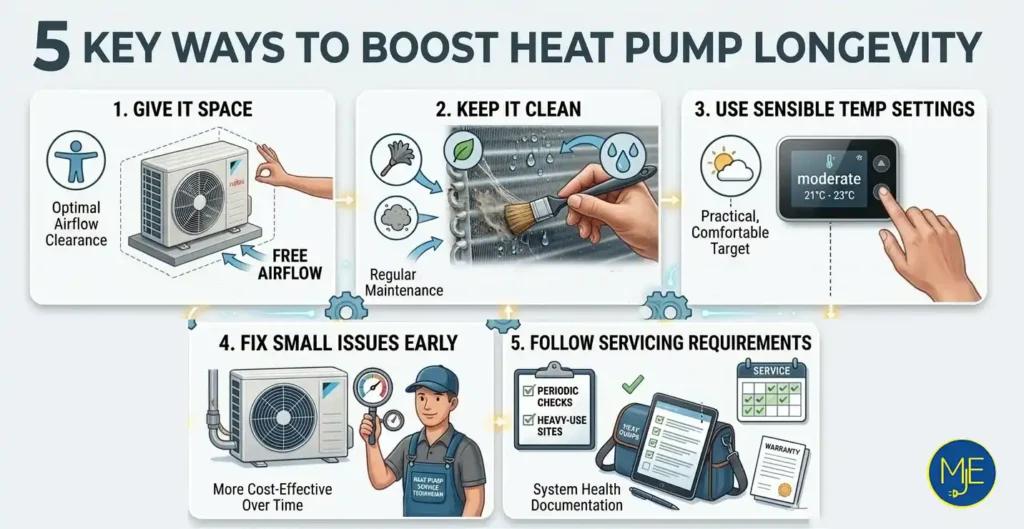
- Give it space: Keep the area around the unit clear so it can pull in air and reject cooler air properly.
- Keep it clean: Dust, lint, leaves, and cobwebs around the air intake area are small things that turn into big efficiency losses.
- Use sensible temperature settings: Extra-high temperature targets can increase workload. Your installer can set you up for safe, practical temperatures that suit your household or business.
- Fix small issues early: A minor leak, a noisy fan, or a weird error code is usually cheaper to address early than after it causes collateral damage.
- Follow servicing requirements: Some warranties and manufacturers expect periodic checks, especially for heavier-use sites.
Think of this as the heat pump version of changing oil in your car. You can skip it, but you’ll pay later.
How often should a heat pump be serviced in Australia?
There isn’t one universal servicing schedule, because heat pumps vary by brand, design, and site conditions. The best rule is simple: follow the manufacturer’s guidance and match it to your usage.
For households, many people treat it like other major appliances: occasional checks, plus servicing if performance changes. For businesses or strata-style setups, a planned schedule is more common.
Hot water systems, including heat pumps, require regular checks and maintenance, and that this is similar to servicing a reverse cycle air conditioning unit.
For higher-demand systems, especially in commercial environments, maintenance planning is part of good asset management. Victorian technical guidance focuses heavily on good design and monitoring so the expected performance and savings can actually be realised.
If you’re installing new, ask your installer to explain:
- what your manufacturer expects for servicing
- what conditions could affect service frequency, like coastal air or hard water
- what “normal” performance looks like for your usage
That way, you can spot change early, instead of waiting for a cold shower.
What does a typical heat pump service include?
A good service is not just a quick look and a thumbs up. It’s about confirming the system is safe, running efficiently, and not quietly developing a bigger problem.
Because heat pumps involve refrigeration components, it’s important that the right people work on the right parts. ARC states that a Refrigerant Handling Licence is required for anyone carrying out work that involves refrigerant or components that could risk refrigerant being emitted, including installing, commissioning, servicing, maintaining, and decommissioning refrigeration and air conditioning equipment.
From a practical perspective, servicing often includes checks like:
- electrical safety and connection checks
- inspection for water leaks and corrosion
- checking airflow pathways and keeping the heat exchange area clean
- confirming the unit is heating and recovering hot water as expected
- checking unusual vibration, noise, or error codes
For businesses, you may also want documentation of the service and performance checks, especially if hot water uptime is business-critical.
What is the heat pump servicing cost in Australia?
Heat pump servicing cost in Australia depends heavily on your setup, your location, and whether you’re servicing a single household unit or a larger central system for a business or strata building.
A reputable heat pump installer might charge about $1,300 per year for two six-monthly service calls to check the operation of a heat pump system in a typical apartment complex of 40 apartments.
That does not mean every job costs that amount. It does show a realistic ballpark for a planned service program on a larger shared system.
For a single household, costs are usually quoted based on:
- access and installation location
- whether it’s an integrated or split system
- whether parts are needed
- the nature of the problem, routine check versus fault diagnosis
The best move is to treat servicing like insurance: budget for it, then use it to avoid the expensive failures that happen when issues are ignored.
What are the signs my heat pump is nearing the end of its life?
Most systems give you warnings. The trick is noticing them early and deciding whether it’s a service issue, a repair issue, or a replacement moment.
Common signs include:
- hot water running out faster than it used to
- longer recovery times after showers or high usage
- unusual noise that’s new or getting worse
- recurring error codes
- leaks, rust, or visible corrosion around the unit
- a noticeable jump in energy use for the same hot water habits
Some of these problems are simple fixes. Others point to major component wear. Either way, ignoring symptoms is how a small problem turns into a full replacement.
If you run a business, also factor in downtime risk. Even if a repair is technically possible, the cost of disrupted operations can make replacement the smarter call.
When should I replace my heat pump?
If you’re wondering “when should I replace my heat pump”, you’re usually already experiencing one of two things: frustration or fear that it’s about to fail.
Replacement makes sense when the system is no longer reliable, no longer efficient, or no longer economical to keep patching.
A practical replacement decision usually comes down to:
- Age: if you’re approaching the “up to 15 years” lifespan range, replacement becomes more likely, especially if problems are stacking up
- Major component failure: compressor or refrigeration-side issues can be more expensive, and may require licensed refrigerant technicians
- Repeat repairs: when you’re paying for callouts every few months, it often stops making financial sense
- Performance drop: if it can’t keep up with normal demand, even after servicing
- Site changes: renovations, occupancy changes, or business growth can mean your existing system is no longer correctly sized
If you’re not sure, a good installer can assess performance, age, condition, and likely repair pathway, then tell you whether it’s worth repairing or time to upgrade.
Is it better to repair or replace a failing system?
Here’s an easy way to think about it: repairing is great when it restores reliable performance for a reasonable cost. Repairing is painful when it becomes a cycle of temporary fixes.
For businesses and larger sites, design guidance encourages looking beyond upfront cost and considering quality, system lifetime, warranty, support, and whole-of-system performance.
A simple decision approach is:
- If the system is generally healthy and the issue is isolated, repair is usually worth it.
- If the system is older and the issue suggests wider wear, replacement often wins on long-term value.
Also consider safety and compliance. Refrigerant-related work is regulated, and national guidance highlights permit requirements and the role of Refrigerant Handling Licences in the refrigeration and air conditioning industry.
If you’re a household, the calculation is mostly cost and convenience. If you’re a business, add the cost of downtime and the value of predictable hot water supply.
How do I maximise lifespan from day one when installing a new heat pump?
This is the part most people skip, then regret later. If you want a long-lasting system, the real work starts before installation.
First, choose a system that suits your climate and your demand. The Australian Government notes that not all models are designed for cold locations where it regularly drops below about 5°C in winter, so model selection matters.
Second, treat sizing as a design task, not a guess. For commercial and industrial applications, understanding your energy consumption profile and not treating heat pumps as a simple one-for-one boiler replacement.
Third, don’t shop on price alone. The same guidance encourages looking at system lifetime, quality, refrigerant type, COP, warranty, and support, not just upfront cost.
Finally, make sure the right people do the right work. If servicing or installation touches refrigerant components, ARC is clear that a Refrigerant Handling Licence is required for work that could risk refrigerant emissions, including installing and servicing refrigeration and air conditioning equipment.
If you do those four things, you’re already ahead of most installs.
A heat pump can last a long time if you look after it
A heat pump hot water system is not a fragile piece of kit. In Australia, guidance commonly describes heat pump system life as up to 15 years, and that’s achievable with the right install, good placement, and sensible servicing.
If you’re planning a new installation, dealing with a system that’s struggling, or you simply want to keep your heat pump running efficiently for as long as possible, our expert Ballarat electricians at MJ Electrical can help with heat pump installation, maintenance, and repair.